



AI and citizen participation: From research to practice
/
When Ireland Twiggs ran her first citizens’ panel in Derry~Londonderry, she ended up with hundreds of pages of flip charts in her house. Writing up what residents had said took nearly eight months.
That delay matters. People who give their time to a public process want to know someone is listening. OECD research shows that feeling heard is the single strongest driver of trust in public institutions. When results take months to surface, participation can start to feel like one more exercise that goes nowhere.
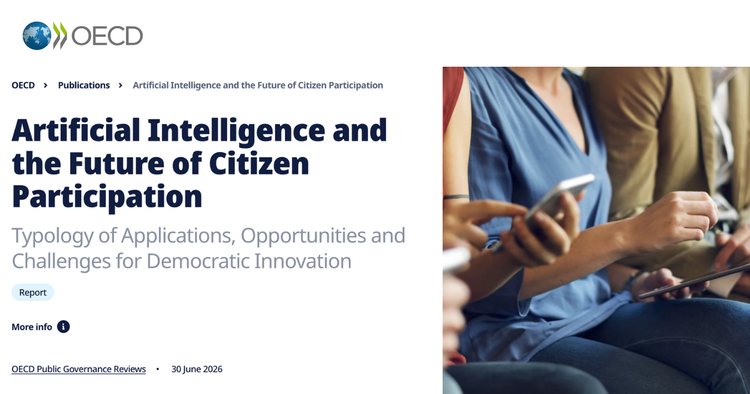
Governments and organizations are now turning to AI to help. A new OECD report, Artificial Intelligence and the Future of Citizen Participation, initiated in close collaboration with and co-funded by Bertelsmann Stiftung, maps how. It draws on 50 use cases from 22 countries and groups AI tools by the problems they help solve.
In September, People Powered, the OECD and Bertelsmann Stiftung brought the report to practitioners in a two-part sequence. Participants first attended a webinar to learn about the key findings and their practical implications. A follow-up, hands-on workshop then gave participants the chance to work through their own challenges with the people behind five AI-supported initiatives. More than 750 people registered for the two events, and nearly 300 people from 65 countries and territories joined us live.
As Stefan Roch of Bertelsmann Stiftung put it, the field needs to move past both hype and doom: “We need real evidence about where AI helps, and where it falls short.”
Bertelsmann Stiftung has lived this tension itself. Over 15 years, the foundation has moved from Germany's first nationwide citizens' forum, with more than 10,000 randomly selected participants, to the 2024 Forum Against Fakes, which combined a citizens' assembly with an online consultation and is featured in the OECD report.
Where AI is helping citizen participation
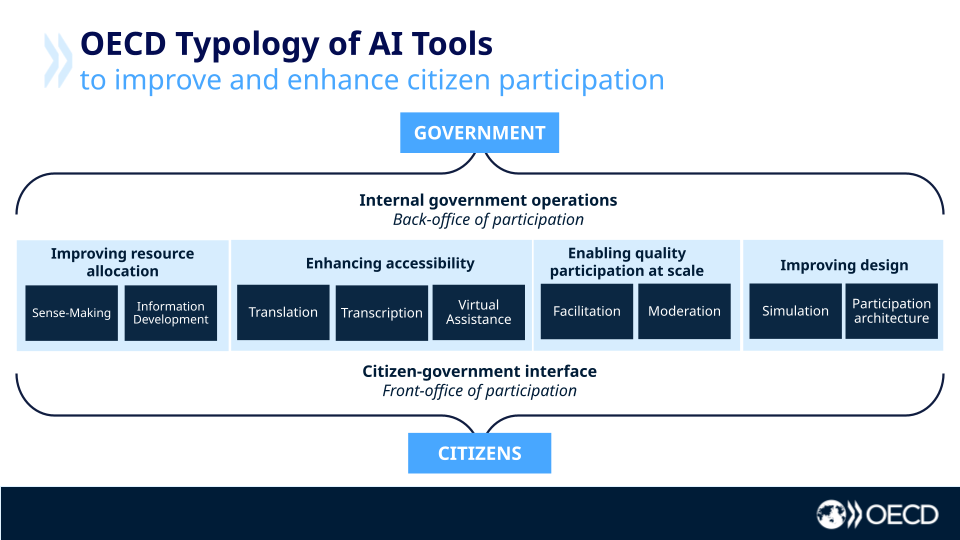
The OECD report includes a Typology of AI tools to improve and enhance citizen participation (see Picture 1). The Typology includes 9 Types of Applications (Sense-Making, Information Development, Transcription, Translation, Virtual Assistance, Facilitation, Moderation, Simulation, Participation Architecture), which are needed both for internal government operations (the “back office” of participation) and in citizen-facing activities (the “front-office” of participation). These Types of Applications provide four main benefits: (1) Improving resource allocation, (2) Enhancing accessibility, (3) Enabling quality participation at scale, (4) Improving design. During the two webinars, practitioners showed what this means in practice.
Lessons from case studies
1. Freeing up time: Let AI handle the paperwork
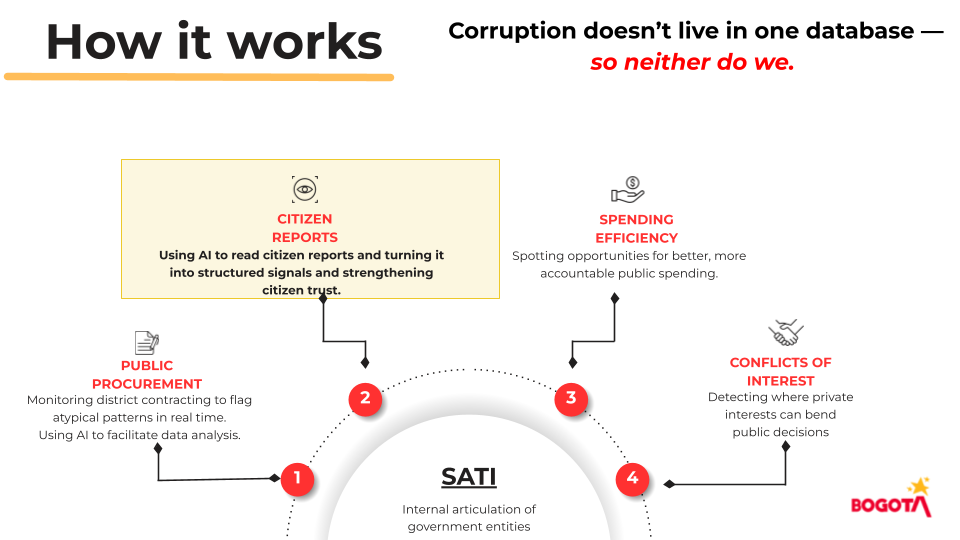
Participation creates a lot of material, and someone has to make sense of it. In Bogotá, residents send a constant stream of complaints and reports to the city. Sofía Garzón Gómez of the Mayor’s Office shared how SATI, the city’s early warning system, uses AI to sort these reports, route them to the right agency, and flag possible corruption.
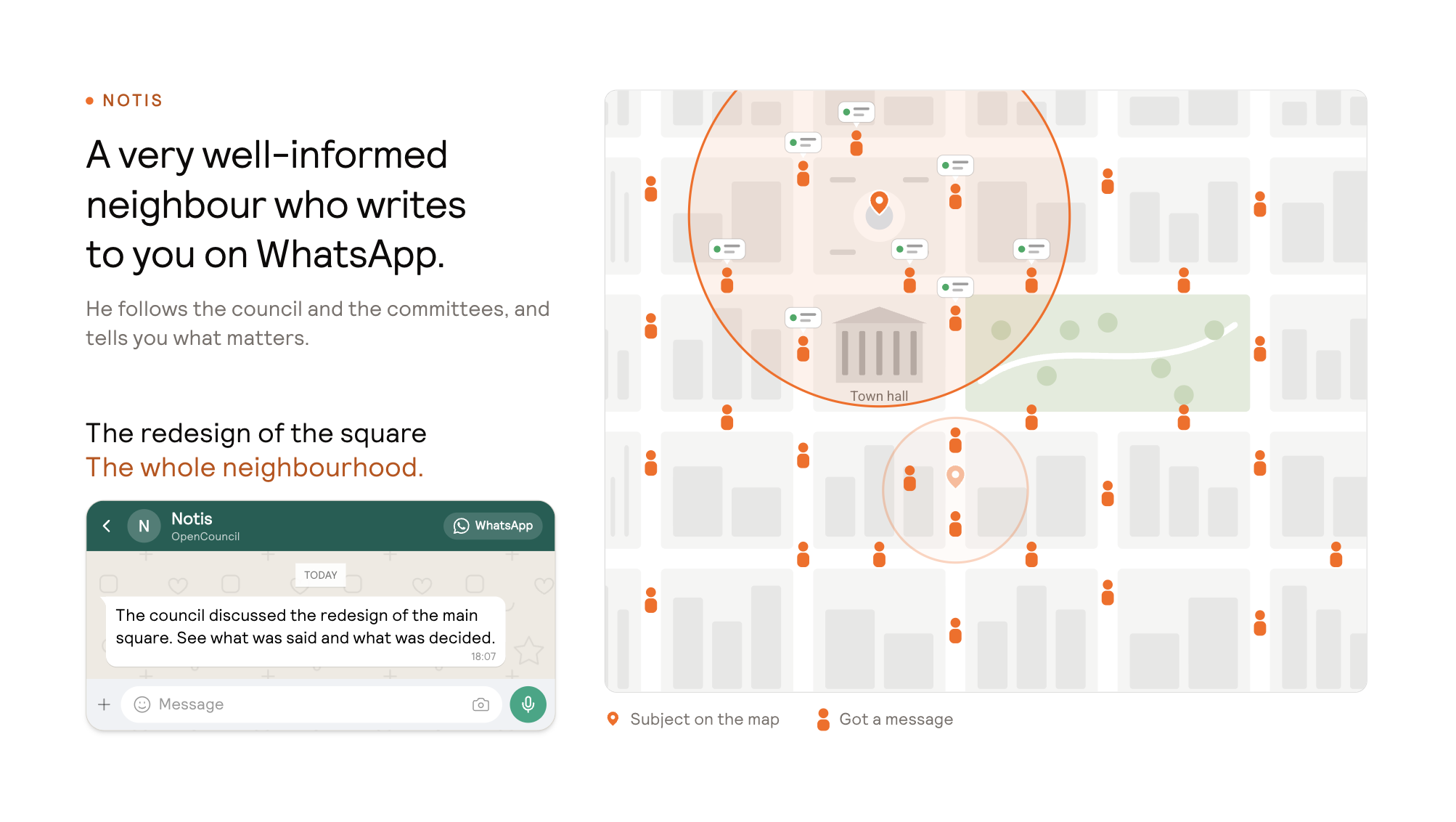
In Thailand, the challenge was access. Records of parliamentary committee meetings were public but locked away in thousands of scanned PDFs. WeVis used AI to turn them into a searchable public website. In Greece, OpenCouncil took over the work municipalities were already paying for, such as transcribing council meetings and drafting minutes.
For Ireland, the change was dramatic. Her latest panel report reached decision-makers with high level insights and themes within a month instead of eight.
CoPlanAI, presented by Sampo Ruoppila, does the same for participatory planning workshops: instead of staff sorting through piles of sticky notes and sketches, AI groups residents' visualised proposals and shows which ideas recur across the group.
2. Widening access: Meet people where they already are
Most people won’t visit a participation website. “No matter how cool your website is,” said Christos Porios of OpenCouncil, “people are not just going to watch a city council meeting on a Thursday evening.”
So OpenCouncil, one of the report’s case studies, sends residents in 14 Greek municipalities WhatsApp alerts when their council discusses their street or an issue they care about. Sign-ups have come more easily on small islands than in Athens, including from older residents who already use WhatsApp to message their children.
Bogotá’s chatbot Chatico, also in the report, works in a similar way. Residents can ask questions and send proposals to public challenges and plans over WhatsApp. City staff still go out to show older residents how to use it, and the bot always offers a human if someone wants to interact with one.
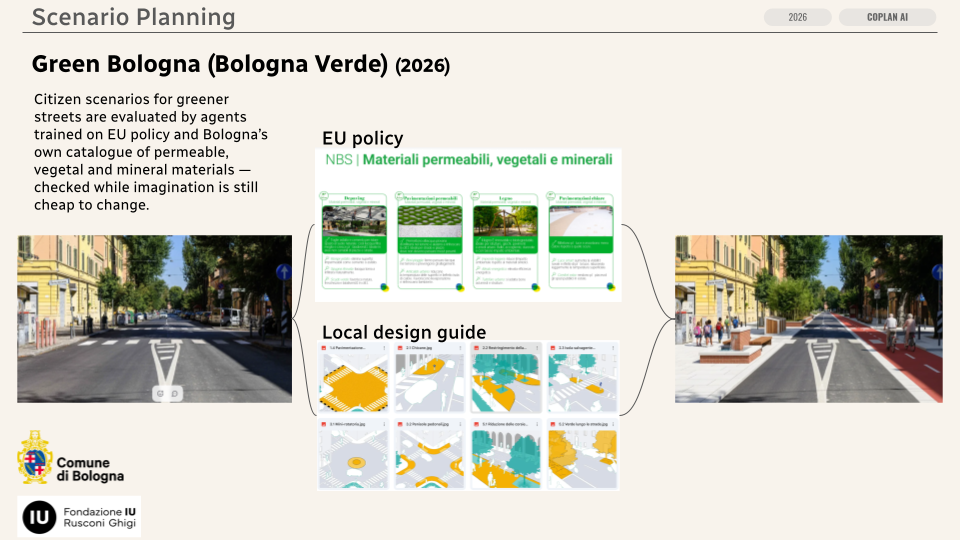
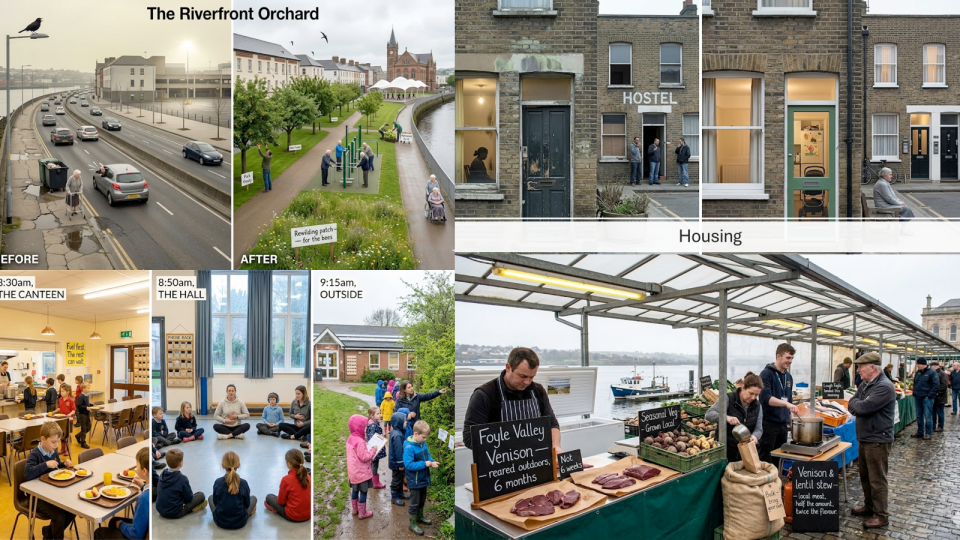
CoPlanAI tackles a different barrier: the language of planning. Many residents struggle to comment on drawings and zoning maps, but they know their own streets well. CoPlanAI lets participants describe how they would improve a familiar public space, and AI turns their ideas into images of that very place. The pictures make proposals easy to discuss, and the platform then analyses them to show decision-makers and planners what kind of changes people would prefer.
3. Keeping quality at scale: Support facilitators, don’t replace them
Good deliberation depends on skilled facilitators, and note-taking pulls their attention away. At Co-operation Ireland’s panels, the Dutch tool Dembrane transcribes each table’s discussion and maps how conversations develop across the room. It also flags possible misinformation, but only to facilitators, so they can raise it gently. “You don’t ever want to call someone out,” Ireland explained.
The result, she said, was that AI let her team “slow the process down while simultaneously speeding it up.” Facilitators could give more time to participants who needed it, including those with varying literacy levels. Participants also became more open, not less, once they saw their ideas being captured.
We tried this ourselves. At both events, deliberAIde transcribed the discussions and turned them into visual summaries.
4. Expanding what’s possible: Let AI show, not just tell
Words can mean different things to different people. “What is ‘more green’ for me, what is ‘more green’ for you, might be completely different things,” said Sampo Ruoppila of CoPlanAI. The tool turns residents’ ideas into images of their own streets. In Helsinki, a case the report cites (with their former collaboration UrbanistAI), one group’s idea of a “playful” square became the guiding concept for the final design.
Pictures can include people that text-heavy processes leave out. Children draw on the images. Residents describe changes in their own language. In a facilitated session, Sampo said, the digital divide is “close to zero.”
They can also show how modest — and achievable — people’s hopes often are. When Co-operation Ireland asked residents to picture their city’s future, nobody asked for flying cars. They asked for locked entrances, benches and homes without mold.
The guardrails it needs
The report is just as clear about the risks, from exclusion to public resistance, and it sets out guardrails to keep AI in a supporting role. It also warns against the opposite mistake: avoiding AI altogether and missing what it can offer. The practitioners we heard from have each built their own guardrails in practice.
1. Don’t flatten disagreement

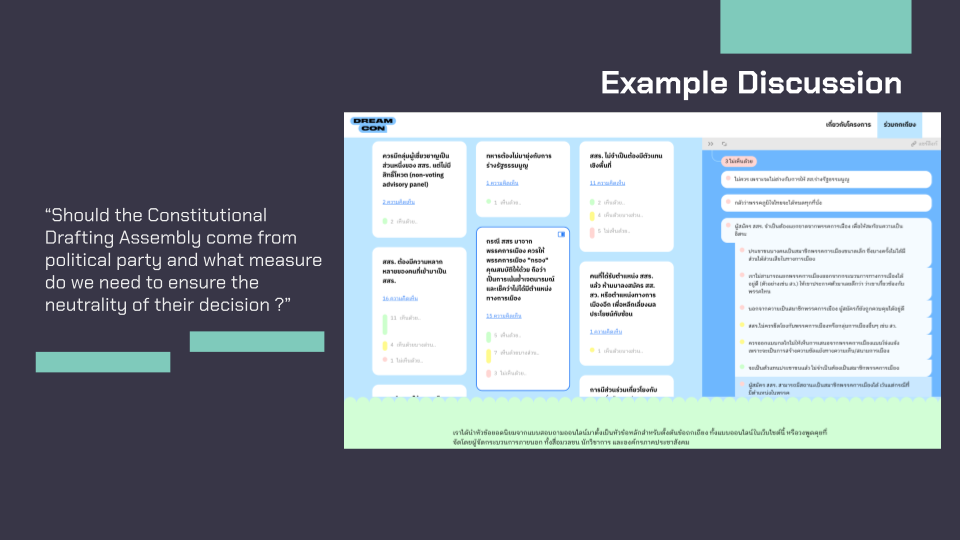
AI summaries tend to reflect the majority view. When WeVis tested summaries for DreamCon, its platform for public input on Thailand’s new constitution, three people in a group of five agreeing became “most people agree.” The other two disappeared.
So WeVis changed its approach. Its AI now groups discussions around the questions people were answering, and policymakers read what people actually said. Giulia Cibrario of the OECD warned against letting efficiency drive these choices: “Democracy is not about efficiency and productivity, , democracy is meant to be slow, democracy is meant to be frictional.”
2. Keep people in charge
The report recommends that governments clearly define AI’s supporting role. Every practitioner described doing exactly that. “In the end, it’s always us as human beings that end up making the decisions,” said Sofía.
At Co-operation Ireland, each table checked and corrected its own AI summary before it reached the organizers. Instead of raising doubts, this built confidence. Participants could see the tool was getting it right.
Expectations need managing too. “No matter how fancy a picture you get, it will not be built like that,” Sampo said. CoPlanAI is for learning people’s preferences, not for making the design.
3. Be transparent about tools and data
“Recording a conversation is not a neutral act,” said Ireland, who works in a post-conflict society. Co-operation Ireland chose a tool that anonymizes audio, keeps data on European servers, and doesn’t use participants’ words to train its models. Every participant went through consent one by one, and Dembrane’s founders came to Derry~Londonderry to answer questions in person.
In Bogotá, a new tracking system records who opens each report, which helps protect people who report corruption. In Greece, OpenCouncil’s software is open source, so anyone can see how it works.
4. Leave room for people to say no
Participants raised harder questions too. Who owns these tools? Should democratic processes depend on technology controlled by a few large companies? What do they cost the environment, a growing concern among young people? These questions don’t have easy answers yet.
What practitioners can do is offer real choices. Our own workshop included an AI-free breakout room for anyone who preferred not to be recorded. Respecting that choice is part of making sure AI doesn’t become another reason people stay away.
The conversation is the point
At the end of the workshop, Stefan reflected on what AI should be for. “The conversation is a means to an end,” he said, “but it’s also the end in itself.”
At its best, AI takes on the clunky work around that conversation, or makes it easier for them to understand each other, so people have more room to listen, disagree and change their minds.
People like to feel heard, and when they are, it makes their cities feel like it belongs to them. AI can help more people’s voices to be heard, at scale. For Ireland, the result goes beyond efficiency. When residents see their words reflected back quickly and accurately, she said, it builds hope that this time, things will change.
Read the OECD report: Artificial Intelligence and the Future of Citizen Participation →
Short on time? Read Bertelsmann Stiftung's policy brief, which pulls together the report's recommendations for governments
Choosing a tool for your own process? Start with our Guide to Digital Participation Platforms.
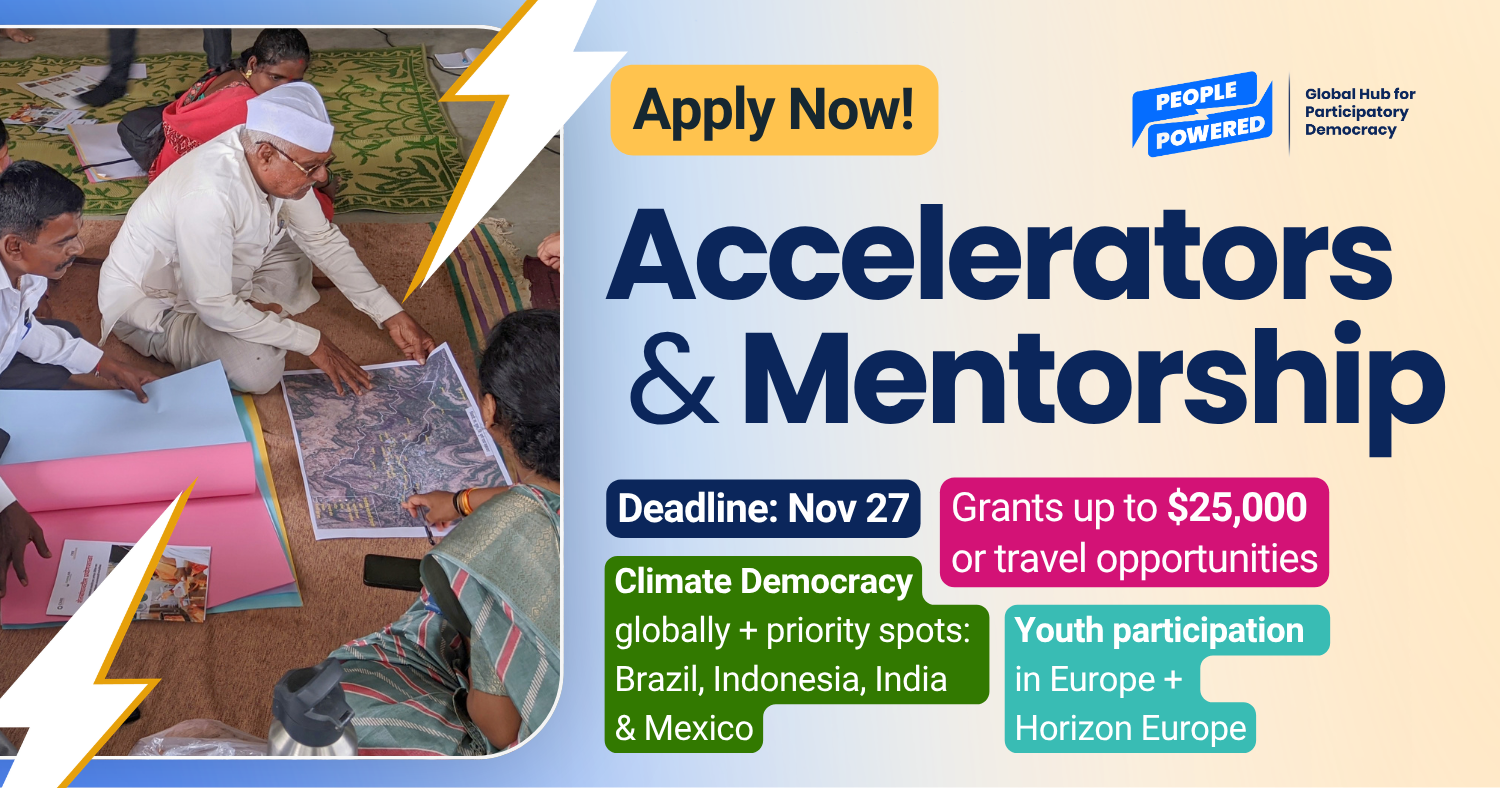
Ready to put this into practice? If you're a government or civil society organization in an EU or Horizon Europe country working to strengthen youth participation, apply to our Democratic Innovations Accelerator: six months of mentoring, training and peer learning, plus an all-expenses-paid, in-person workshop. Applications close November 27. Outside Europe? Our Climate Democracy Accelerator is open worldwide, and Rising Stars mentorship has spots for People Powered members everywhere. See all open programs →
More resources: Webinar recording · Case studies: Co-operation Ireland, WeVis, Chatico · Platform ratings
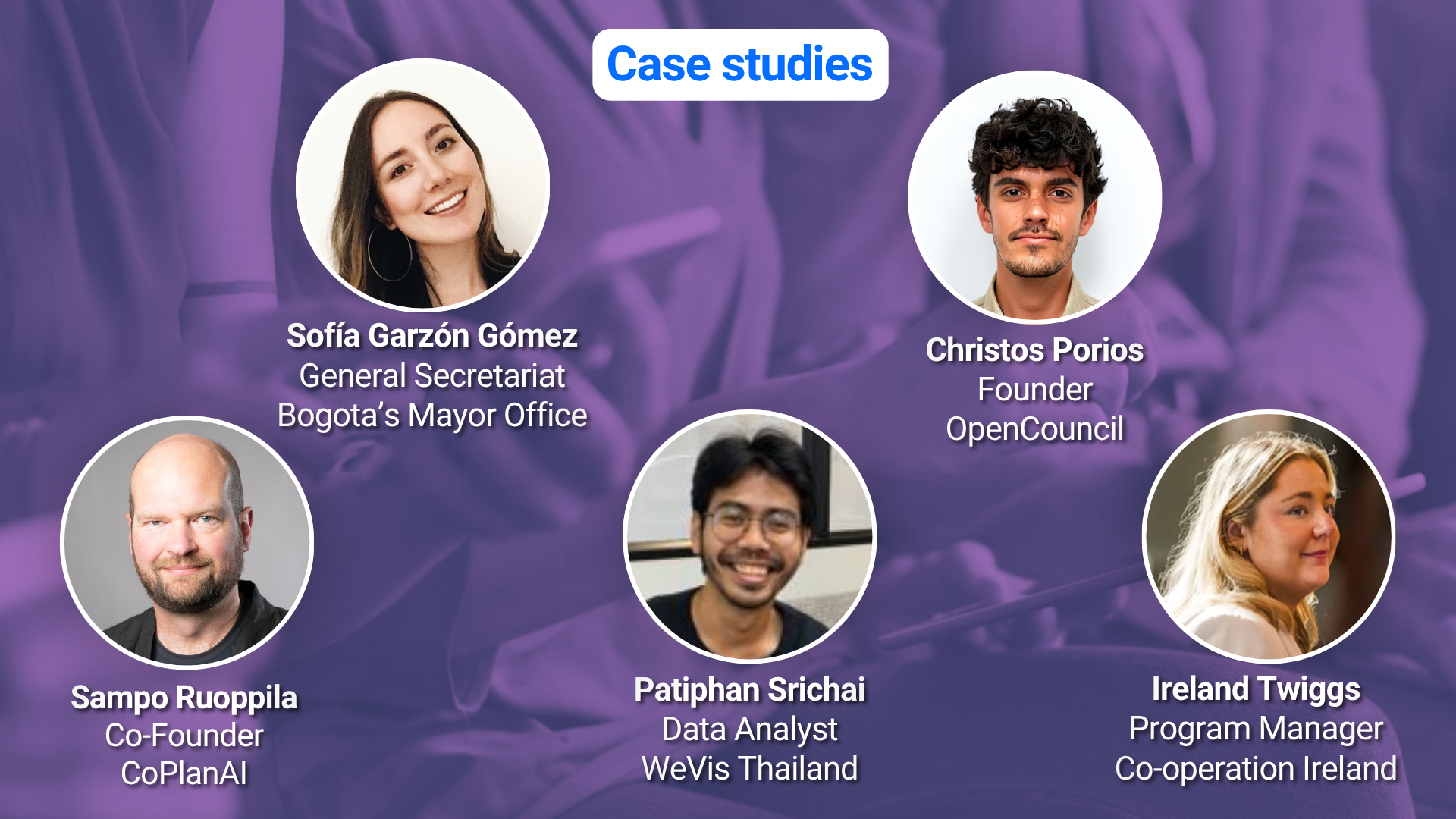
Thank you to our case study speakers: Sofía Garzón Gómez of the General Secretariat of the Mayor’s Office of Bogotá, Christos Porios of OpenCouncil, Sampo Ruoppila of CoPlanAI, Ireland Twiggs of Co-operation Ireland and Patiphan Srichai of WeVis. Thank you also to Giulia Cibrario of the OECD and Stefan Roch of Bertelsmann Stiftung for presenting the report’s findings; to Angela Jain, Florian Wagner, Celina Pereira and colleagues at both organizations; and to Lukas Salecker and the deliberAIde team.
These events were made possible with support from Bertelsmann Stiftung.