



Who Should Decide the Future of AI? These Universities Put Students in Charge
/Written by Ryan Gem, Learning and Evaluation Manager, People Powered
Process photography by Vera Arzumanyan, AUBG alumnus

As generative AI rapidly reshapes education, work, and public life, policymakers are struggling to answer a simple question: who gets to decide how AI should be used? Over 80% of Americans and Europeans feel there needs to be greater regulation of AI usage. Yet, top-down restrictions often prove difficult to enforce, especially when AI use is hard to detect and even harder to monitor. But what if the people were empowered to design AI regulations?
With support from People Powered, a consortium of six European Universities tested a simple but radical approach: the people most affected by AI policies should help write them. The project’s success serves as a model for applying participatory policymaking approaches to AI regulation more broadly.
Novel Problems…
Universities everywhere have struggled to respond to the rapid spread of generative AI. A 2026 global study by the Digital Education Council found that 88% of students and 77% of faculty actively use AI in higher education. While less than 3 in 4 students said instructors were well equipped to guide AI use, an equivalent majority of educators worried students’ reliance on this technology comes at the expense of developing their own research and critical thinking skills.

The situation at American University in Bulgaria (AUBG) was no different. As project coordinator of the university’s Center for Information, Democracy, and Citizenship (CIDC), Vlada Kolesnikova, recalled: “There was a lot of erosion of trust between the faculty and the students. Faculty were navigating in the dark on how to deal with AI. What does it mean for teaching? What to do with plagiarism now? And with students, it was basically a free-for-all situation. If you don't get caught, you can keep using it.”
Like many universities confronted with the sudden rise of generative AI, AUBG’s first instinct was prohibition. It quickly became clear that banning AI was unlikely to solve the problem. The rapidly evolving nature of AI meant that faculty were constantly trying to keep pace with the changes in order to police plagiarism and academic dishonesty. While students felt a constant pressure to use AI even in the face of a ban. Both because employers expected new graduates to be proficient in the new technology and because they worried they might be at a disadvantage if their classmates used AI on assignments.
…Demand Novel Solutions
Universities often make decisions from the top down. While students may have some opportunities for input, major policies are typically developed by administrators and faculty, then simply handed down to students. But on the issue of AI policy, in Vlada’s view, “it felt particularly important to give more power to the students. They’re directly affected by the policies the university implements on AI use.” So why not give them the power to help decide AI policy?
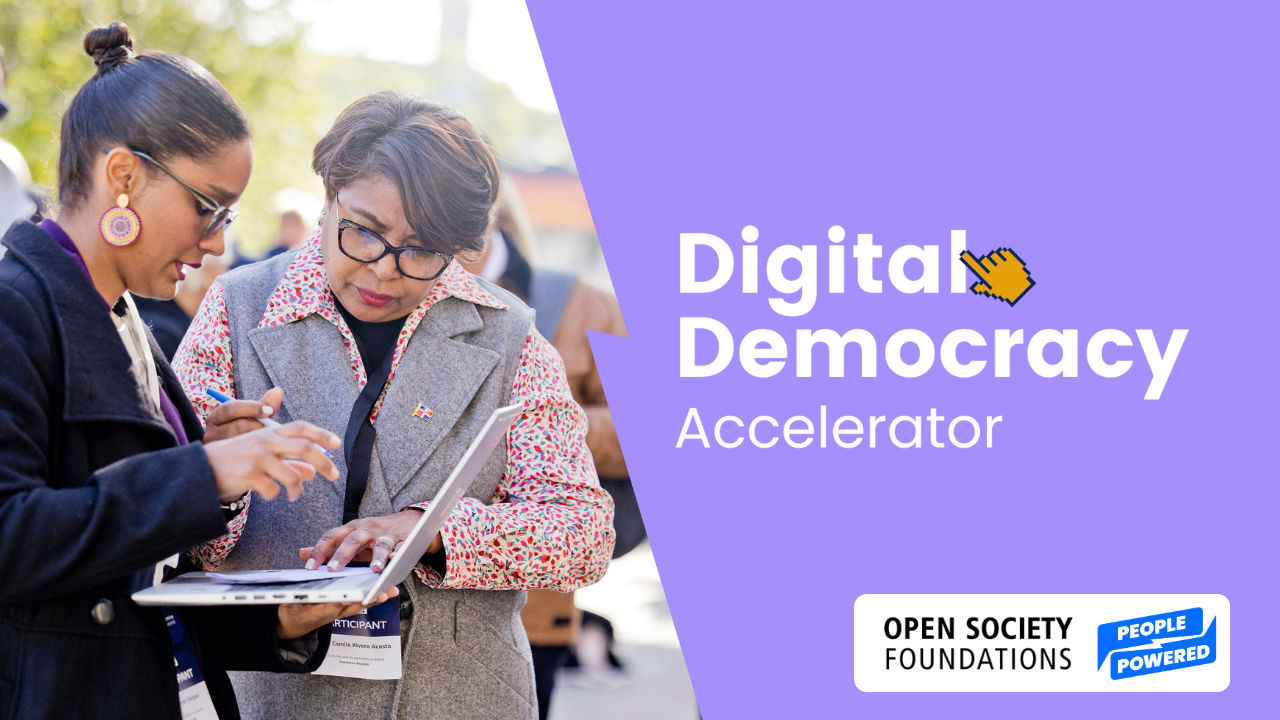
Through People Powered’s Digital Democracy Accelerator, Vlada Kolesnikova transformed an ambitious idea into an actionable project. She received mentorship, seed funding, and structured support to turn participatory governance principles into practice and bring her vision to life. Her proposed project would let students and faculty decide together how AI use in the classroom should be governed.
For Vlada, who was taking on one of her first major responsibilities in a new role at the CIDC, the support from People Powered made a significant difference. She received expert mentorship, resources, project funding, and the opportunity to learn from similar democratic innovations all around the world.
Vlada also credits the Director of the CIDC at the time, Tihomira Doncheva, who worked with her to develop the project plans, constructively challenging her ideas and thinking, while allowing her to grow and take on a larger leadership role in the project.
Similarly, Vlada appreciated her “wonderful mentor,” Annie Cook, provided as part of the DDA, “who just helped us grow this project,” offering insights gained from her years of experience as a Director of Deciding Matters.

The mentorship sessions became a laboratory for brainstorming, testing ideas, refining plans, and solving problems before they emerged in practice. Together, they developed a detailed action plan that ultimately became the project’s roadmap.
“It was wonderful, because we already had a blueprint of what we wanted to do and how it could work.”
The Accelerator also helped build skills that proved valuable during implementation, particularly adaptability. Whether managing power dynamics, adjusting discussion formats, or responding to participant feedback, the team repeatedly drew on lessons learned through the program and ongoing support from their mentor.
“There was always a person to lean on and rely on when there were questions,” Vlada recalled. “There is no need to navigate completely in the dark.”
The Promise of Participatory Methods
As the project took shape, its great promise quickly became clear. Recognizing the project's potential, People Powered awarded an additional US$100,000 in funding to help scale the effort across five additional universities.

The participatory approach to AI policy development devised in the Digital Democracy Accelerator evolved into the AI Aware Universities initiatives, which ultimately brought together students, faculty, staff, and administrators from across six university communities to co-create the AI policies that would govern their institutions.

Bringing together diverse perspectives for inclusive conversations with a shared mandate to develop solutions through democratic problem-solving created some surprising outcomes. Faculty members who entered the process concerned about widespread misuse of AI began hearing directly from students about how and why they were using these tools. Students, in turn, gained an opportunity to explain their experiences and the pressure they felt to use AI in their work.
The conversations didn't eliminate disagreement, but they transformed it into a viable path forward. It also helped forge genuine understanding of each other's perspectives and concerns, while creating a renewed sense of shared purpose. Most importantly, it empowered students and faculty to address AI use on their own terms.
Learning to Share the Room
While the project faced some challenges in its implementation, there were several lessons learned that are applicable to others who might want to emulate the approach.

1) The process should accommodate participants’ real lives
The program was intentionally designed to unfold over a long timeline to ensure there was sufficient time for deliberation. However, the implementers found that maintaining engagement over a project that spanned several months created its own challenges, especially as student participants had to balance this work with busy class schedules, assignments, and exams.
2) To encourage true participation, the design must address existing power dynamics
Since the process included professors, staff, and students there were clear power differentials among these groups. Organizers found that faculty members tended to speak more often while students were hesitant to take up space. In order to rebalance the discussion, the team devised a simple yet elegant solution: a card system.
Each participant received two cards. Every time someone spoke, they turned over a card. Once both cards were used, they had to wait before speaking again, creating space for others to contribute.
3) Local facilitators build both trust and long-term capacity
In order to manage deliberative discussion groups across six campuses, the team needed more facilitators. They decided to train 38 student facilitators to help lead the conversations. This not only helped create trust in the process since facilitators were members of their communities, but also empowered students to be leaders of the policy development process.
It also further helped students gain confidence in managing the power dynamics mentioned above. At first, some student facilitators felt hesitant about interrupting professors or redirecting conversations. Over time, however, they grew into their roles. “They all managed wonderfully,” Vlada remarked. “All of them eventually found their way.”
Finding Common Ground
As the project neared its conclusion, the team anticipated contentious debates and potential deadlocks between faculty and students as they finalized their recommendations on AI use. “I really expected people to disagree on a lot of points,” recalled Vlada.

Surprisingly, there was a remarkable amount of agreement, not just between faculty and students but also across universities. Though each university’s framework was unique to its institutional context, there were clear themes across all six of the AI policy proposals.
In their own way, all of the proposals affirmed a commitment to academic integrity, with students supporting the responsible and limited use of AI as much as their instructors did. There was also broad recognition of AI’s limitations and a recognition that it should only be used in limited human-centered applications. Students and faculty agreed that ongoing AI literacy and education for all community members was crucial. Many of the policies also recognized the need to keep AI policies agile as the technology is quickly evolving. AUBG, for instance, explicitly proposed a living document approach to their AI policy with regular review and mechanisms for updates and revisions as needed.
The most resounding support, however, was for the process itself. There was unanimous agreement that AI policies should continue to be developed from within the university community rather than imposed from above.
For the project team, witnessing this level of agreement emerge was a powerful moment. “Seeing so many hands up at the end of the day was rewarding,” said Vlada. It was a physical manifestation of the power of deliberation to build consensus even on contentious and complex issues. Even more encouraging still was the fact that after reviewing the recommendations, university administrators expressed a readiness to implement them in full.
The Transformative Power of Participation
The policy recommendations that emerged were only part of what made the project successful. Equally important was the influence of the participatory process on those who engaged and the example it set for navigating other policy challenges.
Students experienced what it felt like to help shape institutional policy. Faculty saw the value of hearing directly from the experience of their students. And partner universities began exploring how similar participatory approaches could be applied to other administrative challenges.
Vlada reflected that the process helped university administrators to realize that “students are not just consumers of what’s happening in the university, they’re also the actors themselves, and they can shape policy.”
It also empowered students to take more ownership of their role in policymaking. At one of the AI Aware universities, before the process had even concluded students were already advocating for future university issues to be addressed through similar participatory approaches.

For Vlada, that lasting shift in mindset may be the most inspiring outcome of all: “the communities and people affected by the issues know their needs. For organizations and community leaders who want to empower their community to make decisions by themselves and take the lead and be the changemakers,” participatory policymaking can be truly transformative.
This and other projects that emerged from the Digital Democracy Accelerator, like the national youth assembly on digital policy in Poland, powerfully demonstrate that when young people are trusted and given the tools and space to deliberate, they are capable of creating thoughtful, practical solutions to some of the most complex problems of the moment.
The effective regulation of AI is in high demand around the globe, and governments are failing to deliver actionable policy solutions. The AI Aware Universities initiative suggests that people do not need to be technical experts to meaningfully shape AI policy. Given the opportunity, information, and support to deliberate together, students, faculty, and community members can develop thoughtful, practical approaches to governing emerging technologies.
At a moment when trust in institutions is strained and governments around the world are struggling to keep pace with AI’s rapid evolution, that lesson extends far beyond university campuses. The question may not be whether citizens are capable of helping shape AI policy. Projects like this suggest the real question is why we so rarely invite them to do so.
Take action!
Want to keep the conversation going? Join us on September 16 for How Is AI Changing Citizen Participation?, a webinar with OECD and Berteslmann Stiftung that unpacks new research on AI and participation, featuring case studies from practitioners already putting these tools to work.
Get support. Working on participatory governance yourself?
Rising Stars Mentorship pairs advocates, civil servants, and policymakers with expert mentors for individualized coaching.
Accelerator programs are focused 6-month programs with free resources and training that culminate in your own action plan. The next cycle of the Accelerators opens soon. Stay connected to be informed when it does.
Partner with us. People Powered provides training, mentorship, and funding to help organizations launch participatory programs like this one. If you're a funder, institution, or organization interested in bringing participatory approaches to AI governance or other complex policy challenges, we'd like to hear from you.