

The antidote to alienation is participation: Lessons from Greater Manchester’s New Participation Playbook
/
Guest author: Tabz O’Brien, Greater Manchester Combined Authority (and People Powered member)
Greater Manchester (UK) is pressing play on a new way of doing things: one where decisions are made by the people, for the people – where community power and participatory democracy thrive.
Through GM Live Well, participation is embedded across health, social, and economic systems - tackling inequalities and reimagining everyday support with, not for, people. Greater Manchester is building a people-powered movement in which residents across ten municipalities shape the services, policies, and decisions that affect their lives.
Community leadership and collective action run deep in Greater Manchester’s story – from the Rochdale Pioneers to the reformers and suffragettes, to the Manchester cotton workers who refused slavepicked cotton. Our region-wide commitment to community power and participatory democracy builds on that legacy. In the past five years, participatory democracy practices have multiplied across the region, from the 2020-21 legislative theatre initiative to co-create Greater Manchester’s first Homelessness Prevention Strategy, which involved over 35 residents with experience of homelessness and more than 300 policymakers and stakeholders, and won the 2022 Best Practice in Citizen Participation Award from the International Observatory of Participatory Democracy (IOPD); to a new participatory budgeting project in 2025 in which 200 young people voted on how to spend over £200,000.
These projects are just several of the local examples included in the Playbook, alongside accessible, illustrated introductions to a variety of participatory tools and best practices for inclusion and impact. The Playbook was co-designed and written by a group of local participatory practitioners – including Katy Rubin and Jez Hall, both People Powered members leading on legislative theatre and participatory budgeting, respectively, along with Liz Mytton (participatory grantmaking and participatory arts); Caroline Tosal-Suprun (citizens’ assemblies and juries); Patrick Tierney (community reporting and evaluation); and Kyle Soo (participatory design).
The evolution of the Playbook, from initial idea to tangible result, was a true participatory effort between the Live Well team in regional government and the communities and practitioners already paving the way.
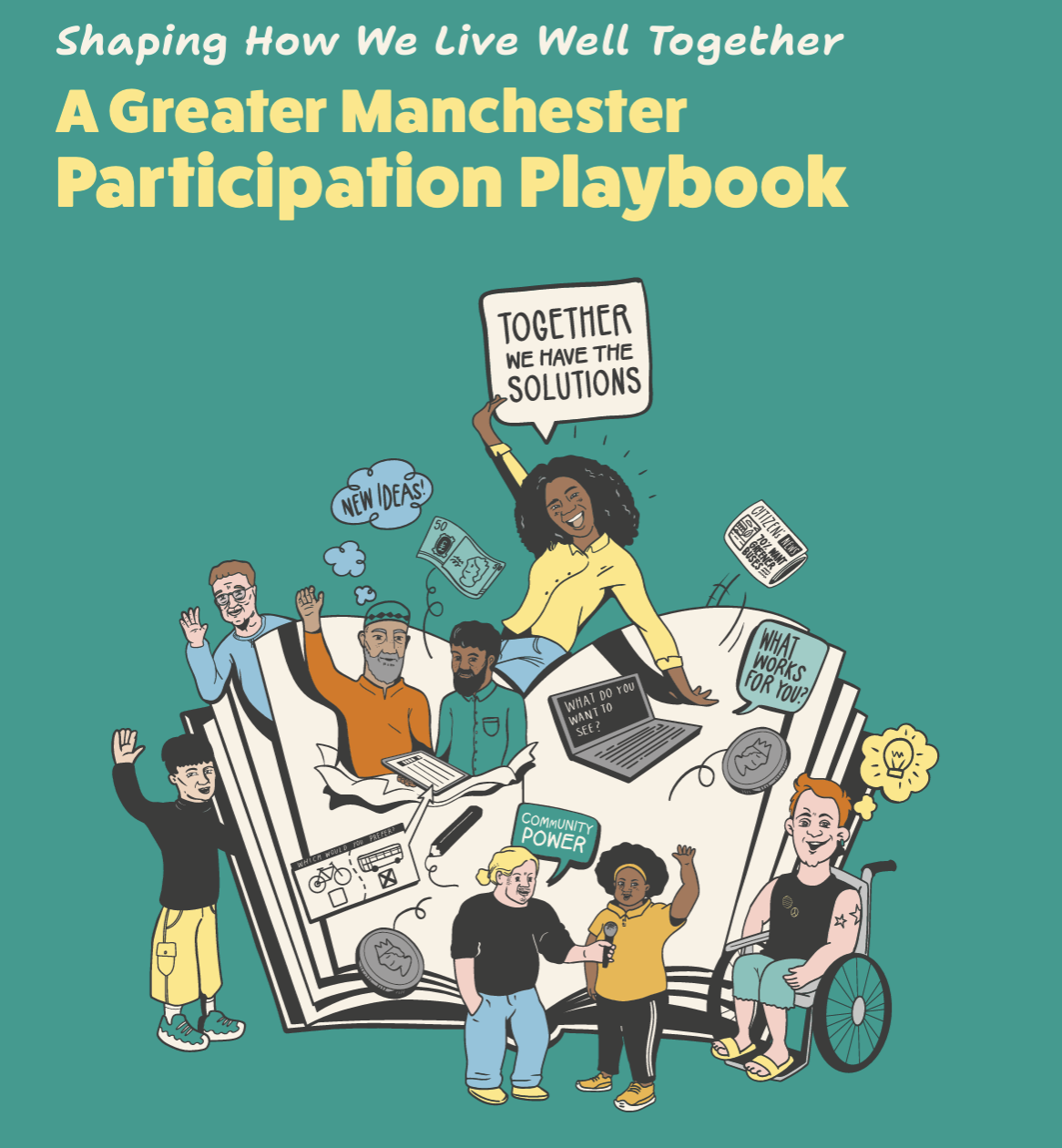
Recently, more than 250 people from community organisations, public services, academia, business, and activism gathered for the launch of Shaping How We Live Well Together: A Greater Manchester Participation Playbook. As both the launch and the Playbook itself were co-designed by participatory practitioners, artists, and community members from Greater Manchester, the event felt less like a launch and more like a participation party. The atmosphere was hopeful, energised, and united in its message: people-powered democracy must become the norm, not the exception.
The Mayor of Greater Manchester made a powerful statement: The antidote to alienation is participation. In a time of deepening inequalities and low trust in institutions, he argued that the path forward is not more centralised decision-making but a shift towards sharing power. “When people are trusted, they rise to the challenge,” he said—calling on leaders to create the conditions for communities to shape the decisions that most affect their lives.
The Playbook itself offers practical tools and real examples across seven participatory approaches—from participatory budgeting and grantmaking to citizens’ assemblies, digital democracy and community reporting. But participants emphasised that its deeper value lies in modelling a cultural shift. The call to action in the room matched that heard in cities worldwide: that now is the time to press play on participation.
Momentum is already building. Public services are exploring how to embed the Playbook into commissioning, policy design and neighbourhood planning. Universities are aligning research with participatory principles. Community groups are using it to strengthen local organising. And global networks—including People Powered—have expressed strong interest in Greater Manchester’s whole-system approach to democratic renewal, seeing it as a model for regions seeking to rebuild trust and redesign governance around community power.
The sense of possibility was captured by a community organiser who said, after hearing examples from Paris, Melbourne and Mexico City: “It makes you feel like there IS a future.” Jon Alexander, author of Citizens, described the significance of hearing a major UK political leader recognise participation not as “nice to do” but as “the answer for our times.” Leah Chikamba-Mulando, a community champion from Angels of Hope, put it plainly: “Community power isn’t a project — it’s a movement. And when we trust, equip, and listen to our communities, transformation becomes possible.”
The Participation Playbook demonstrates Greater Manchester’s commitment to making participation central to achieving Greater Manchester Strategy aims—reducing inequalities, prevention, trust, community power, and better outcomes. The Participation Playbook marks a step-change—providing shared language, practical methods and a clear commitment to building a system in which communities and institutions shape decisions together.
Greater Manchester will continue to work with partners, residents and the global participatory democracy community to turn this energy into action. The Playbook is free, practical and ready to use: download it, experiment with it, adapt it—and help build a future where participation is not an add-on, but the way we live well together.
The new Greater Manchester Live Well Podcast explores what happens when communities lead—and what systems can do to grow community action, power and wealth.