




Impacts of Citizens’ Assemblies: A Summary of the Latest Research
/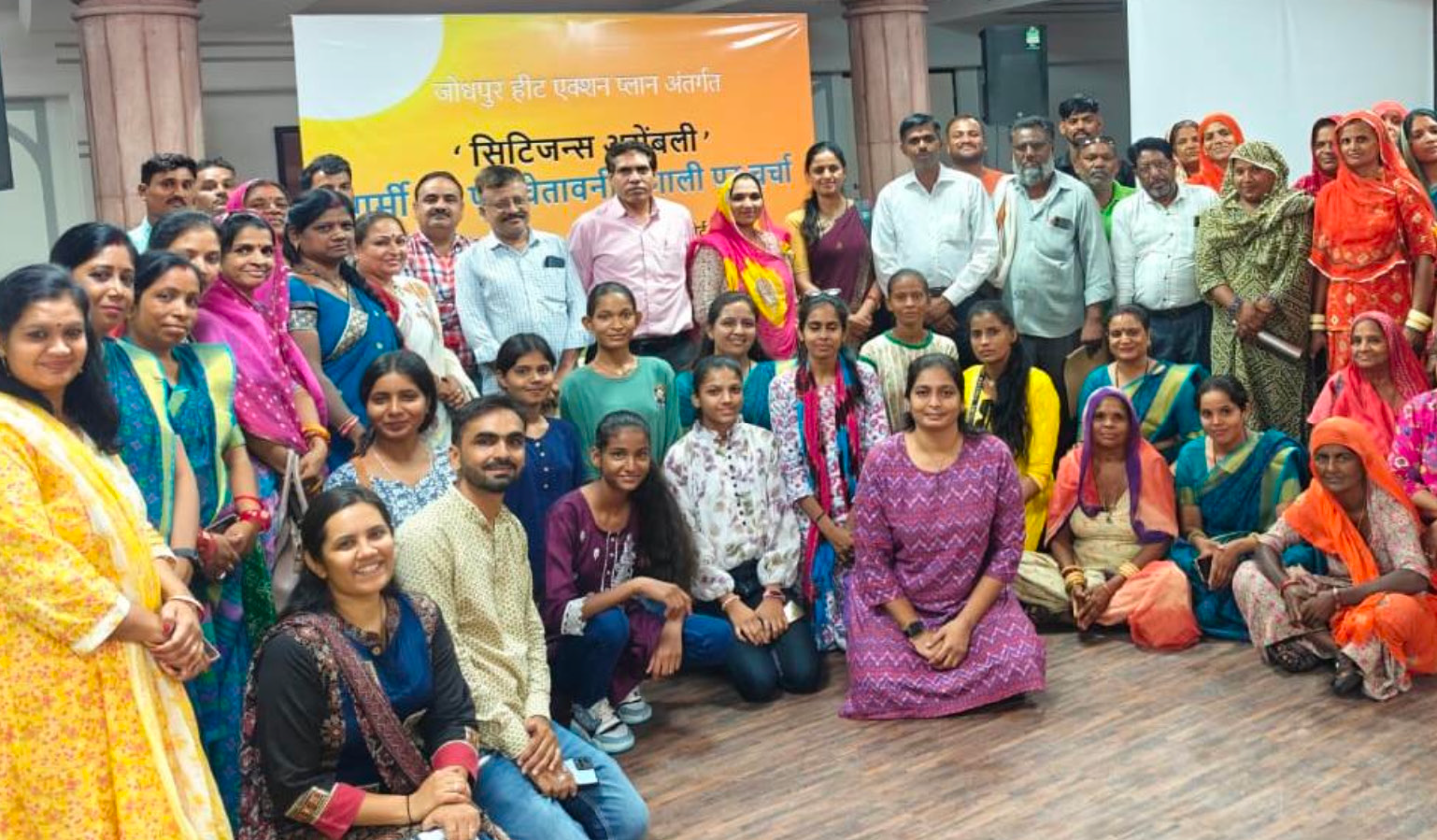
Citizens’ Assembly to develop early warning systems for dangerous heat waves in Rajasthan, India (Mahila Housing Trust)
Citizens’ assemblies have gained considerable momentum in the last decade as an innovative tool for participatory deliberation, agenda setting, and policymaking. But what do we know about their impacts? We read nearly 70 studies (so you don’t have to) and synthesized the latest research into 19 key findings to help you understand, advocate for, and implement citizens’ assemblies.
At the individual level, global research shows that citizens’ assemblies reliably increase the knowledge, skills, and political efficacy of those who participate directly in the process, and can even contribute to depolarization by helping citizens with more extreme political views find common ground.
At the community level, there is consistent evidence of positive spillover effects to those who simply learn about the assembly process and recommendations, such as increasing trust in government and their fellow citizens, and increased willingness of non-participants to engage in politics and consider alternate political views.
At the level of government, citizens’ assemblies can even reshape traditional government processes and dynamics, broadening legislators’ perspectives, bypassing institutional deadlocks, and giving a public mandate for policy action on long-term challenges like climate change.
Since the first modern citizens’ assembly (CA) in British Columbia, Canada was held on electoral reform in 2004, well over 700 CAs have been convened around the world. While many governments and activists have advocated for this approach as one of the best ways to involve citizens in critical decisions, identify novel policy solutions to complex challenges like climate change, and make recommendations for improving their communities, as a relatively recent innovation in participatory democracy, the full breadth of CAs’ impacts is still emerging.
Though a growing number of studies and evaluations seek to understand the effects of CAs, much of the literature is inaccessible, either locked behind paywalls or presented in dense academic language that can be indecipherable even for native English speakers. Plus, most practitioners in government and civil society simply do not have the time to sift through dozens of studies to find information relevant to their needs. We did the work of summarizing all the most recent research, incorporating learnings from 66 studies across five continents and 24 countries.
Navigating the Airtable Database
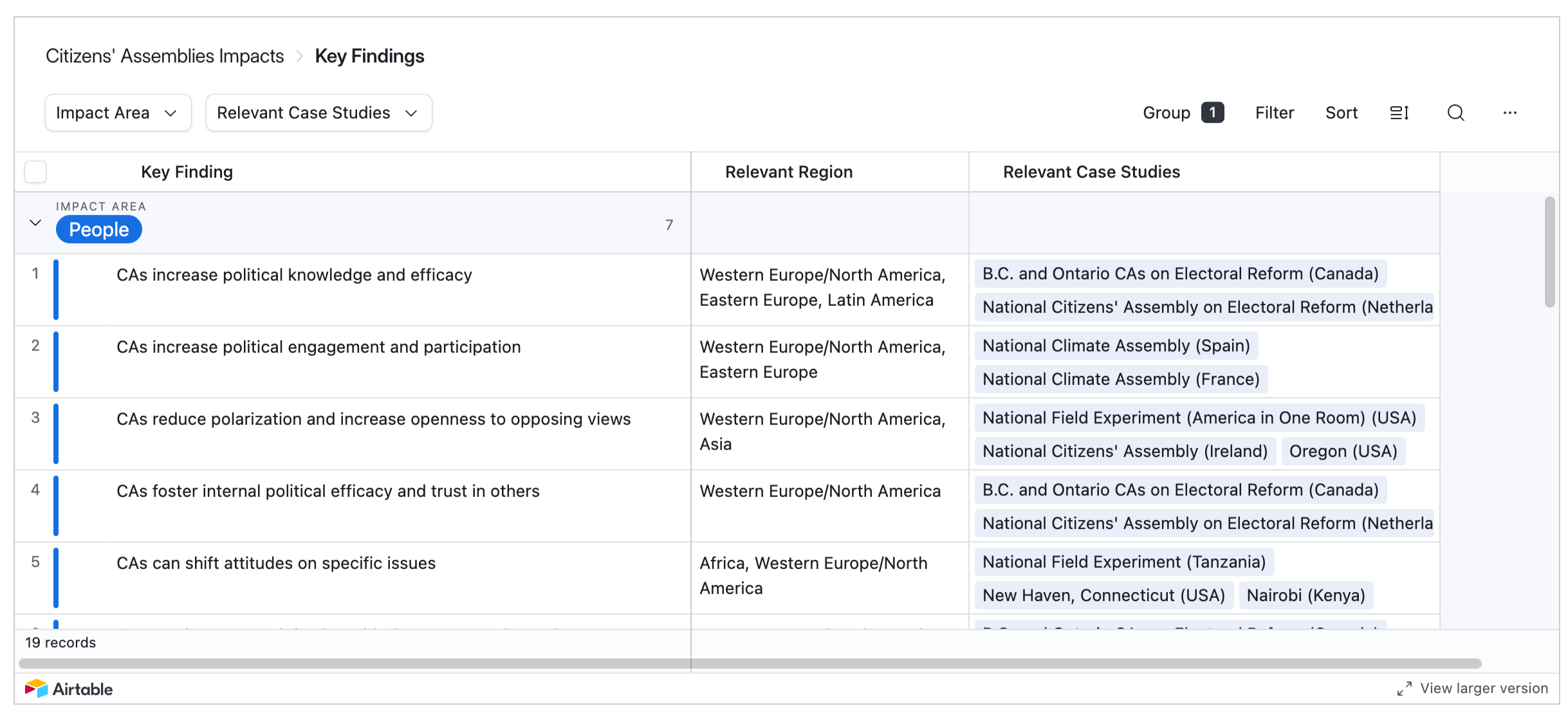
Screenshot of new interactive airtable
The data are organized into 19 key findings illustrating the impacts of citizens’ assemblies on people, communities, and governments and presented in a downloadable research brief and an interactive Airtable. Each key finding is supported by at least three separate studies. We include details of each study including geographic location, type of assembly, and methodology used. We also offer evidence-based recommendations for advocacy; planning and design; and research, monitoring, and evaluation to aid practitioners and researchers in making decisions at every stage of implementation.
Using the Airtable, you can sort the findings by impact area, region, or case study and apply filters to find the information most relevant to your context or need. For example, if you are interested in creating a community-based advocacy campaign to build support for a Climate Assembly in Poland, you can easily filter the data in Airtable to focus on Community-level impacts of CAs, identify studies and findings from other European climate assemblies, or even pull examples from case studies of other CAs in Poland.
What’s next for participatory democracy research?
This brief is part of a running series of topic-specific research briefs available on our website. This series now includes impact data summaries for participatory budgeting, school-based participatory democracy, and citizens’ assemblies. We are working to further expand our research offerings to support practitioners advocating for, designing, or implementing other participatory and deliberative methods, like legislative theater and participatory policymaking.
Whether you want to persuade a government decision-maker to pursue participatory democracy in your community, learn from other experiences about how different process design choices led to particular outcomes, or get inspired about the transformative potential of participatory and deliberative programs, we hope you find these resources useful.
If you’d like to stay updated on our research work, you can follow us on our socials and subscribe to our newsletter. Or, if you have specific requests or ideas for research products that would meet a core need for you or your organization, send us an email! We are continually working to refine, expand, and update our research resources to best meet the needs of practitioners.
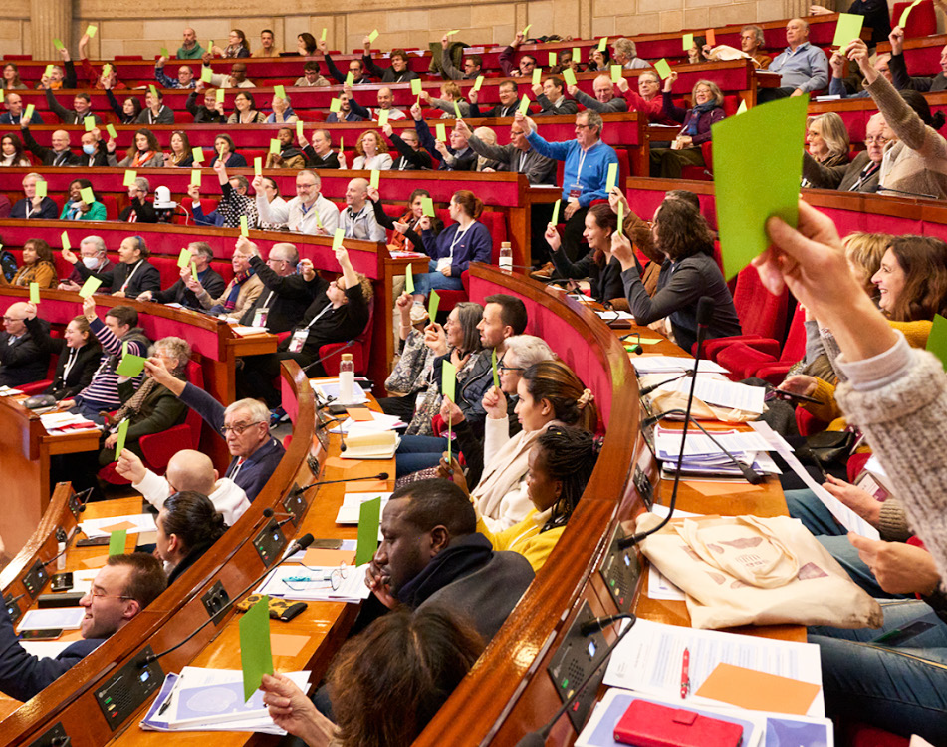
Citizens’ assembly on end of life care in France (CESEl)