

The goal of the Democracy Stories Lab is to develop new creative visions for a more democratic future. We are interested in stories that imagine a better future in which people are in charge of the decisions that affect their lives.
Submissions should build upon the most recent research on common narratives of democracy - “How to Talk About Democracy: What We Know (and Don’t Know)”. They should engage with one of the five families of common narratives identified in the research and should consider the evidence-informed communications guidance in the research brief. Both are summarized below, and for more details, you can read the full research brief here.
What do we mean by narratives?
Think of a mosaic: each tile is a single story — one film, one song, one image. Step back, and the pattern they form is the narrative.
A narrative is the bigger belief about how the world works, built from many stories repeated over time. One story doesn't make a narrative — but a thousand, pointing the same way, can shift what a whole society believes.
The 5 types of democracy narrative
In our research, the same types of narratives about what democracy is and whether it works kept showing up. These are:
Outcome-oriented narratives: how democracy shows results
Intrinsic-value narratives: why democracy is the best choice
Collectivist narratives: what’s the importance of diverse voices
Individual narratives: how democracy is empowering
Process-oriented narratives: showing democratic institutions work
Each of these holds competing stories — some that draw people toward democracy, and some that push them away. You can use these to give your piece direction, and to invite an audience into a more hopeful vision for democracy.
Practical Guidance
Make a compelling and specific case for a more democratic future. The goal of this call is to solicit imaginative and creative visions for a world in which people are truly empowered to have a voice in the decisions that affect their lives. Submissions should engage in some way with one of the five narrative families and advance a vision of the future where people are meaningfully in charge of their lives through the embodiment of democratic values and practices.
Think about the causal story you are telling. What is the who, the why, and the how that helped to achieve the more democratic future you envision. This doesn’t need to be explicit, but it may be helpful to think through these details when designing your submission.
Name the core values your story carries. The core values people hold influence how they see the world and democracy. Thinking through the values you want to convey, might help determine the audience you’re trying to reach (who shares these values) and how the future you envision will help bring these values into practice.
Decide who or what the villain or anti-hero is. Nothing rallies people together like a compelling antagonist. Authoritarian narratives are effective in part because they identify a clear cause of the problems they claim to be solving. While pointing to a specific group can undermine democratic values of inclusion, tolerance, and mutual respect, identifying a systemic grievance like “greed” or “corruption” can help make a story resonate.
Don’t dwell on the negative. While it may be important to acknowledge the current failures or shortcomings of democracy in practice, the main focus of the content should be on a more positive and inspiring imagined future of democracy or democratic practices, principles, and values.
Imagine democracy as it could be, not just as it is. We’re interested in creative visions of a world in which people hold the power to make decisions. Don’t limit yourself to versions of democracy as practiced in the world today, feel free to think bigger about democratic versions of the future.
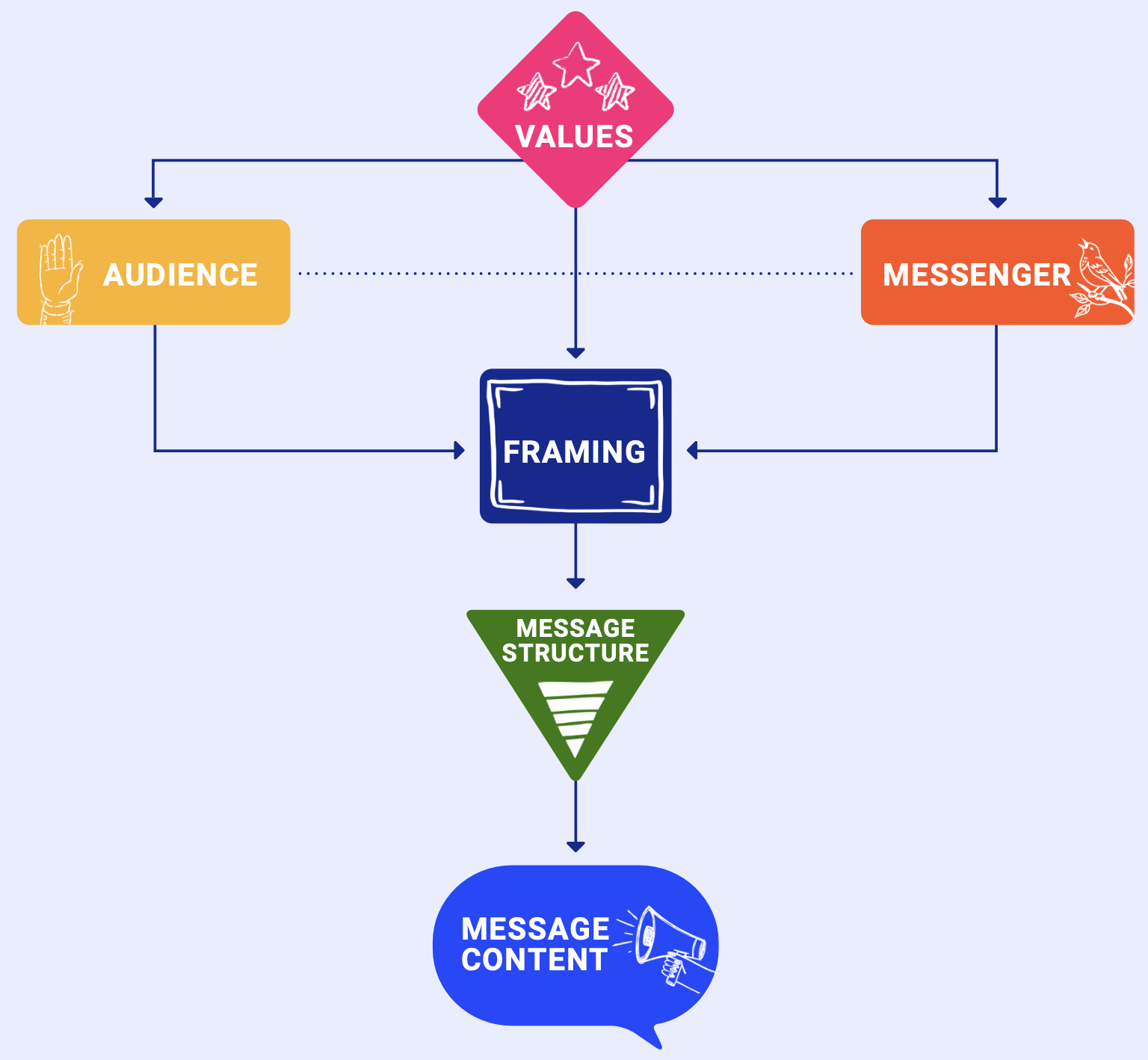
Use the six-element message framework. When developing your story, work through each element in the chart below. For more detail on these elements and how they shape whether a narrative lands, see pages 24–31 of the research brief.